Home Page
PART 7: MATHEMATICS FOR AMATEUR RADIO
LESSON 7
7.7 THE j-NOTATION
7. 7. 1 General
The j notation
is a mathematical tool whose purpose is to prevent confusion between two sets
of figures which relate to different types of quantities. Mathematicians
use the letter "i" but, in electrical engineering, that letter has
other connotations.
7.7.2 Derivation of j
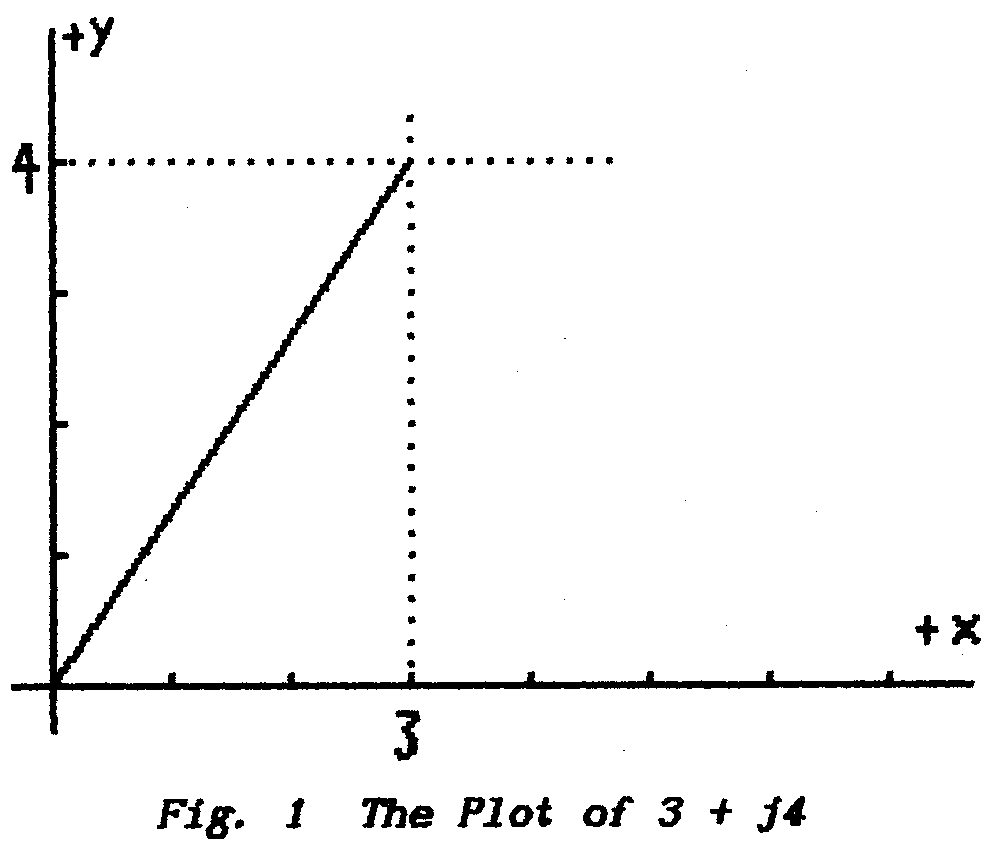 |
Fig. 1 shows two axes which,
by representing two different quantities, are used for plotting graphs
as described in Lesson-3 of this Part. To be more
accurate Fig. 1 shows only that part of each
axis which lies in the first quadrant; i.e. only the positive values
of an independent-variable x (horizontal axis where x may have
any value) and only the positive values of the dependent-variable
y (vertical axis where the value of y depends on the value of x).
As discussed in Lesson-3 a particular point in this
diagram might be designated as 3,4 meaning that x = 3 while y = 4. The
point is plotted in Fig. 1 at the intersection
of a vertical line which passes through x = 3 and a horizontal line drawn
through y = 4. Carry out such an exercise and you will find that, as
predicted by Pythagoras' Theorem, the plotted point lies at a distance
of 5 units from the Origin. |
This diagram shows one instance where simple arithmetical addition of the
values of x and y does not yield the correct answer namely, in this instance,
3 + 4 = 5 . The reason is that x was measured from 0 in a horizontal direction
while y was measured from 0 in a vertical direction while the distance from
point 0 to the plotted point is measured in yet another direction.
To indicate that these two numbers cannot be added except under a set of
special rules the letter j is placed before one of them.
Numbers represented by the length of the horizontal axis are referred to as real
numbers and are written normally. Numbers represented by
the length of the vertical axis are known as imaginary numbers and
are written with the letter j before them. Thus this
particular plotted point can be described as being at a distance 3 + j4
from 0.
Because the two axes are set at 900 the result of this vector
addition can be calculated using Pythagoras' Theorem which
applies to any right-angled triangle namely that the length of the resulting
line is given by:
√(32 + 42) = √(9+ 16) = 5.
However j can be more useful than just an indicator of quantities
which cannot be mixed. It can be used as an Operator which
is a mathematical tool such as + or - .
Its use as an Operator is derived as follows:
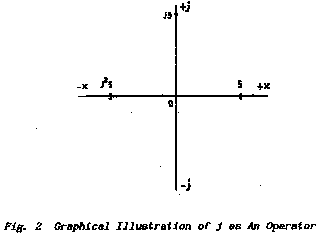
Fig. 2 shows the two axes complete with both negative
and positive values. Along the x (horizontal) axis positive numbers are
represented as line-lengths measured to the right starting from the Origin.
Similarly negative numbers are represented as line-lengths measured to the
left starting from the Origin.
Under the rules of arithmetic:
(a) a positive number becomes a negative number
when it is multiplied by -1
(b) a negative number becomes a positive number
when it is multiplied by -1
This can be represented on Fig.2 by regarding a
multiplication by -1 as a 1800 rotation about the Origin "0". A
second such rotation (another multiplication by -1) returns the plotted point
through a total of 360o to its original position.
Now consider the imaginary axis on which quantities jy are plotted. The
same argument must be applied of course and so multiplication of imaginary
numbers by -1 must also be regarded as a rotation of 180o..
Now that Fig.2 has been constructed under these
rules a small query arises:
a quantity (for example 5) plotted on the horizontal axis is moved to the
vertical axis when a j is placed in front so that it becomes j5.
By direct analogy, if multiplying by -1 rotates +5 through 180o to
position -5 then does not placing a j before it amount to multiplying
that quantity by j so causing a rotation through 900?
This isn't really a fiddle; the diagram was constructed under given
Rules and, if the diagram is to be valid, the Rules must always be observed.
From the Rules the idea arises naturally that an imaginary quantity is to be
regarded as a real quantity multiplied by the Operator j. Similarly
a real quantity has to be regarded as an imaginary quantity multiplied by the Operator j.
Now there is one last step. Multiplication twice by the Operator j (two
rotations through 900 ) clearly leads to a rotation of 1800 already
defined as multiplication by -1. In other words
j2 = -1
which leads to the embarrassing statement that
j = √(-1)
The Rules of mathematics say that minus x minus equals plus
and also that plus x plus equals plus and so there cannot
be any number which, multiplied by itself, equals -1?
You are entitled to deduce from this, if only because it is true, that j cannot
have a numerical value. However it does not necessarily follow that the result
is useless.
7. 7. 3 Use of j as an Operator
As an Operator the symbol j changes a real quantity into an imaginary
one or an Imaginary quantity into a real one. That, under these Rules, j represents
the square-root of -1 is useful when solving problems in Algebra.
Consider for example an inductance in the primary circuit of a transformer. Measured
in the secondary winding this inductance appears as a capacitance because of
the phase-shift that takes place as a signal passes between the windings. (This
effect is utilised to provide frequency-correction in bandpass coupled-circuits
(see under 3.13.4). In a theoretical
analysis of the transformer the reactance (a j-term) in the primary
becomes multiplied by a second j-term which represents the phase shift
between windings; the resulting term contains j2 (
= -1) which indicates that, in passing between the transformer
windings, an inductive reactance is transformed into a capacitive reactance
(true); similarly a capacitive reactance is transformed into an
inductive reactance.
During the course of algebraic manipulations the principle is taken further
and the unwary can fall into some nasty traps. Thus
j3 = j x j2 = j x
-1 = -j
and
j4 = j2 x j2 = -l x
-1 = 1
NOTE These values for j do not
have any arithmetical meaning; they are used only in evaluating algebraic
results in terms of Fig.2.
In Fundamentals-1, Lesson-8 it was simply
stated that the impedance (Z) of a circuit represented by (R + jX)
is found by squaring the two quantities R & X, adding the results and then
finding the square-root of that sum ; in symbols
Z = √(R2 + X2)
That formula also expresses the result of Pythagoras'
Theorem which relates the sides of any right-angled triangle. The use of j to
describe two quantities represented as right-angled vectors is based therefore
on the solution of Pythagoras' Theorem.
This derivation of Z is only valid of course provided that R & X are
truly at right-angles; i.e. that the values refer to "pure" or
theoretically perfect components in which the current and voltage waveforms
are exactly phase-shifted by 900. This does not raise
a problem of course because practical components are regarded as being pure
components degraded by a resistor (representing losses) connected either in
series or in parallel with that component.
The assumption is always true because practical values of L, C & R can
be obtained only by making measurements and, in making these, it is assumed
that the lack of purity is caused by a (theoretical) resistor connected in
one of these configurations.
Back to Top of Page
END OF LESSON